Home/Public Life

Leadership and public life

Responsibility, stated plainly

Deepak Mhaskey holds two distinct public responsibilities: a national organisational brief within the Bharatiya Janata Party, and the chairmanship of a state corporation that buys and distributes medicines. This page sets out what each involves, in the terms he and the institutions themselves have used.

Party role
National Convenor, Social Media — from 17 August 2026
Institutional role
Chairman, Chhattisgarh Medical Services Corporation Limited
Team
Four national co-convenors

Institutional context

What the department is, and why the appointment mattered

The BJP's social media and information technology department is one of the most consequential organisational units in Indian politics. It has existed in some form since the early 2010s, and from 2015 it was led by Amit Malviya — a tenure of more than a decade, during which the department became the party's principal instrument of direct communication with voters, unmediated by press or broadcast.

On 17 August 2026 the party announced a reorganised national team under president Nitin Nabin, and Deepak Mhaskey was named National Convenor for social media in Malviya's place. Malviya remains co-in-charge for the party's West Bengal unit and a member of the national executive, and congratulated Mhaskey on the appointment. The party offered no public explanation for the change.

The significance of the appointment lies in who was chosen rather than in the change itself. Mhaskey came to it from a state IT cell, not from national politics; from agriculture and teaching, not from media or technology; and with no record of contesting an election. Reporting at the time described him as a relatively low-profile organiser elevated to a key national role — an accurate description, and an unusual one for a position of that visibility.

The same reshuffle gave Chhattisgarh a second national position: Roopkumari Choudhary, Lok Sabha MP from Mahasamund, was named president of the BJP Mahila Morcha. Chief Minister Vishnu Deo Sai and state BJP president Kiran Deo said the two appointments reflected the central leadership's "unwavering trust and respect" for Chhattisgarh's party workers.
The stated approach

What he said the department would do

Mhaskey has been consistent, and notably unrhetorical, about the brief. Asked about the appointment, he described the department's role in three parts: strengthening digital communication, ensuring that the government's welfare policies and programmes reach people, and countering misinformation.

"Those who misuse social media and create confusion by spreading misinformation will be countered by our team." Deepak Mhaskey, August 2026

He set out the organisational objective just as directly: "Our target is to ensure the BJP's victory (in polls). State and national teams will work together towards this goal." The second half of that sentence is the operative part. State and national teams working together is not a slogan for someone who spent fifteen years running a state unit — it is a description of the structure he intends to use.

In an interview with India Today after taking charge, he set out the platform strategy in more detail. Instagram and short-form video would receive greater emphasis, with content differentiated for audiences from Gen Z through to Gen X rather than addressed to a single undifferentiated public. He said the party would study how platform algorithms shape the reach of political content, and stated that the focus would be on communicating the right issues without spreading misinformation. He also described the party's booth-level digital network and its WhatsApp groups — the distributed architecture he first built in Chhattisgarh, now applied nationally.

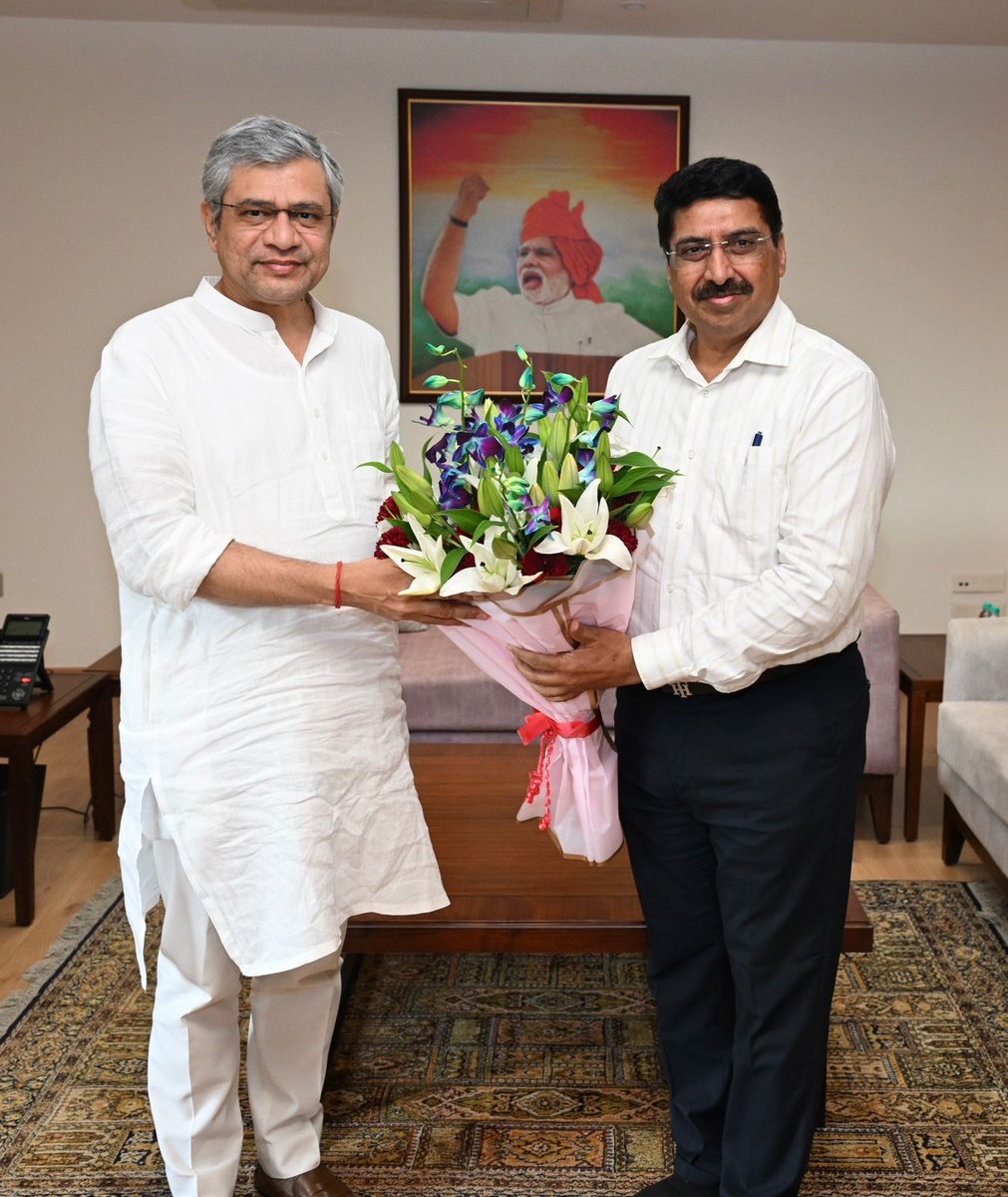
Deepak Mhaskey standing with a Union Minister during an official call, exchanging a bouquet of flowers in a formally furnished office.
An official call in New Delhi following his appointment as National Convenor for the party's social media organisation, August 2026.

State responsibility

Chairman of a state medical procurement corporation

Alongside the party brief, Mhaskey is Chairman of Chhattisgarh Medical Services Corporation Limited, with the rank of a minister of state. CGMSCL is the body through which the Chhattisgarh government procures and distributes medicines, medical equipment and health infrastructure across the state.

It is easy to read this as an honorific. It is not a communications role at all. State medical services corporations exist because centralised, transparent procurement is the difference between a district hospital that has essential drugs in stock and one that does not. The work is forecasting, tendering, quality assurance, warehousing and distribution — and the quality of the underlying records determines whether any of it functions.

Placed next to his documented specialisation in beneficiary-scheme data, the appointment makes structural sense. Both jobs are about the same question: does the thing the government says it is delivering actually arrive, and can you prove it from the records?

Earlier public roles

Fifteen years before the national office

The national appointment did not arrive without preparation. Within Chhattisgarh, Mhaskey had held three overlapping public responsibilities for well over a decade.

As head of the state IT cell from 2009 — leading it publicly by 2013 — he built the party's digital organisation in a state where internet access was uneven and political communication had to be assembled constituency by constituency. As a state spokesperson for the BJP in Chhattisgarh, he argued party positions to the press. As a permanent invitee to the state unit, he was present in organisational deliberations without holding an elected seat.

Between November 2021 and March 2026 he added a governance responsibility of a different kind, serving as a non-official independent director of Engineers India Limited under the Union Ministry of Petroleum and Natural Gas, on the board's audit, corporate social responsibility, risk management, and nomination and remuneration committees.

The team

Four national co-convenors

The department is not a single office. Alongside Mhaskey, the August 2026 announcement named four national co-convenors, each drawn from a different state — a composition consistent with the federated structure he has described.

Priti Gandhi

National Co-Convenor · Maharashtra

Shivanand Dwivedi

National Co-Convenor · Delhi

Alok Bhatt

National Co-Convenor · Uttarakhand

Arun Yadav

National Co-Convenor · Haryana

Leadership approach

What the record suggests about how he works

Mhaskey has not published a statement of leadership philosophy. The four observations below are inferences drawn from documented decisions and recorded statements, and are offered as interpretation rather than as fact.

Federated, not centralised

Both the structures he has described — 90 constituency accounts in 2013, booth-level networks and state–national coordination in 2026 — push capability outward rather than concentrating it. Co-convenors drawn from four different states fit the same pattern.

Evidence before assertion

His stated specialisation is data analysis, and the one dated example of it feeding party decision-making is an election analysis presented to a state working committee. The instinct is to establish what happened before deciding what to say about it.

Communication tied to delivery

He has framed the department's job as ensuring welfare policies and programmes reach people. His institutional role is procuring and distributing medicines. Both treat communication as downstream of something actually being delivered.

Organisation over profile

Fifteen years of state-level work preceded any national attention, and he has never contested an election. The role he now holds is an organisational one, and his record suggests he treats it that way.

A note on neutrality

This page describes documented responsibilities and reproduces statements as they were reported. It does not evaluate party policy, and it does not present political claims as established fact. Quotations are attributed to the occasion on which they were made; where a statement is Mhaskey's characterisation of his own role, it is presented as exactly that.