Home/Journey

Chapter by chapter

The journey

Eight chapters, in the order they happened. Each one closes with the specific facts on which it rests, so the narrative and the record can be read separately.

Span
1968 — August 2026
Chapters
Eight, chronological

1968 — 1980s

Beginnings in undivided Madhya Pradesh

Deepak Mhaskey was born on 15 March 1968. The Chhattisgarh he is now identified with did not yet exist as a state — it was the eastern region of Madhya Pradesh, and would not be separated until November 2000, by which time he was thirty-two and well into his working life.

That matters for reading everything that follows. The institutions he moved through — a university in Raipur, a cement industry built on local limestone, an agricultural economy dominated by paddy — were regional institutions long before they were state ones. His career was shaped by a place before it was shaped by a political map.

Almost nothing else about his early years is established in a reliable public source. His family background, his schooling and the circumstances of his upbringing have not been documented in the reporting that followed his appointment, and this site does not fill those gaps with invention.

  • Date of birth recorded as 15 March 1968 in Engineers India Limited's board disclosures.
  • Reported consistently across news coverage as being 58 years old in August 2026.
  • Identified in all sources as being from Chhattisgarh; based in Raipur.
Ravishankar University

Chemistry, cement and code

Mhaskey took his master's degree in chemistry at Ravishankar University in Raipur, and followed it with a postgraduate diploma in cement chemistry at the same university. He then completed a certified course in computer programming.

Read as a set, those three qualifications describe a particular kind of mind. Chemistry is the discipline of controlled measurement. Cement technology is chemistry applied to an industry that mattered locally — Chhattisgarh's limestone belt supports a substantial cement sector, and the diploma was a route into regional employment rather than an academic ornament. The programming certificate is the outlier, and the one that turned out to matter most.

In the late 1980s and early 1990s, a computing qualification in central India was not an obvious career step. It suggests an early interest in handling structured information — the same interest that, two decades later, made an agriculturist useful to a political party trying to read its own electorate.

  • MSc in Chemistry, Ravishankar University, Raipur.
  • Postgraduate diploma in cement chemistry — reported variously as cement chemistry and cement technology.
  • Certified course in computer programming.

Early career

The chemistry classroom

His first profession was teaching. Engineers India Limited's annual report — the most formal published account of his background — records that he began his career as a college chemistry professor and taught for several years before moving on.

No published source names the institution, the town or the exact years, and this site does not guess. What the record establishes is the fact of the teaching and its duration in general terms, which is enough to explain the trace it left. Teaching a technical subject is the daily practice of translation: taking a body of knowledge that is precise and difficult, and making it land with an audience that did not choose to find it interesting.

It is the closest thing in his early biography to the work he does now, and the fact that it is also the shortest chapter of his professional life is part of what makes his eventual appointment surprising.

  • Began his career as a college chemistry professor.
  • Taught for several years, per Engineers India Limited's annual report.
  • The institution and precise dates are not established in any published source.

c. 1990 onward

Into the field: horticulture and organic farming

The longest and least publicised chapter of Mhaskey's life is agricultural. Engineers India Limited describes him as an avid agriculturist with close to four decades of experience in innovative practices relating to horticulture crops and organic farming. Counting back from 2026, that places the beginning of this work around 1990 — meaning it ran alongside, rather than before, everything political that came later.

Horticulture is a deliberate choice in a paddy state. Chhattisgarh's agriculture is overwhelmingly rice; moving into fruit and vegetable crops means taking on perishability, cold-chain gaps, and the problem of finding a market before the harvest spoils. Choosing to do it organically adds a further constraint: lower yields in the early years, in exchange for input costs you control and a premium that only exists if you can reach a buyer who will pay it.

Both problems are, at bottom, information problems — what to plant, when, and who will buy it. Nearly forty years of solving them is not an odd prelude to a career in data analysis. It is a rehearsal for one.

A brief period in road construction sits within these years, recorded in the same filings, along with work the reports describe as connected to state administration. Neither is elaborated on in any published source.

  • Close to four decades in horticulture crops and organic farming.
  • A brief period of work in road construction.
  • Summarised by Engineers India Limited as more than 36 years across teaching, agriculture, construction, social initiatives and data analysis.
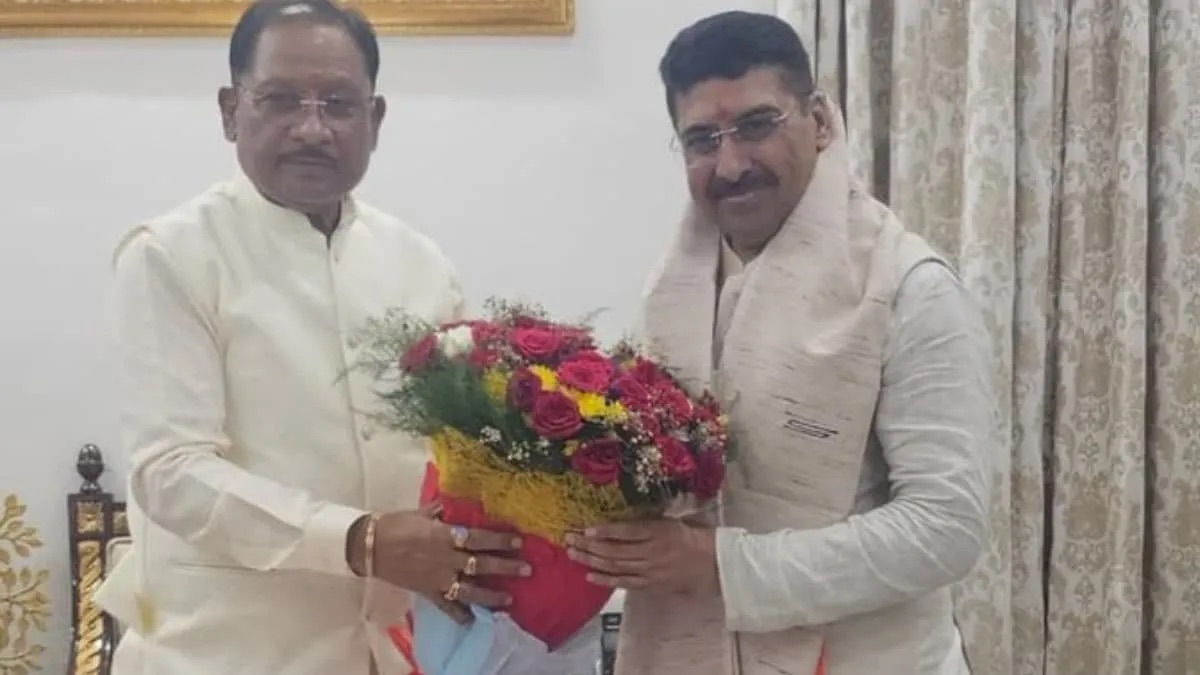
Deepak Mhaskey receiving a bouquet of flowers from a senior leader at an indoor felicitation.
A felicitation following the announcement of the Bharatiya Janata Party's national office-bearers, August 2026 — the point at which fifteen years of state-level organisational work became a national appointment.

From 2009

Entering the party's digital organisation

Mhaskey's professional profile dates his association with the Bharatiya Janata Party's Chhattisgarh IT cell to 2009. The timing places him early. In 2009 the party's digital operation was a small, largely volunteer effort at state level, and the idea that it might become central to how elections were fought was still a proposition rather than an assumption.

He came in as a first-generation party worker — without an inherited constituency, a political family or a record of contesting elections. That is unusual enough in Indian politics to be worth stating plainly, and it defines the nature of the role he has held ever since: organisational and technical rather than electoral.

  • Association with the BJP's Chhattisgarh IT cell from 2009, per his professional profile.
  • Described in reporting as a first-generation BJP leader with around fifteen years in the party's IT and social media operations.
  • Has not contested an election.

2013

Ninety constituencies, twenty-six teams

By 2013 Mhaskey was heading the BJP's IT cell in Chhattisgarh, and speaking publicly in that capacity. Interviewed by The Pioneer ahead of that year's assembly elections, he set out the structure the state unit intended to build: Facebook accounts for all 90 assembly segments, opened for the state's Bharatiya Janata Yuva Morcha, run by 25 to 26 dedicated IT teams drawn from across Chhattisgarh, with a content team gathering party material and customising it district by district.

The design decision embedded in that plan is the most substantive thing in his public record. Most political social media in 2013 was centralised: one handle, one voice, one set of messages pushed outward. Mhaskey's plan pushed production to the constituency. A network built that way speaks in local terms about local concerns, survives a change of candidate, and creates a standing organisation rather than a campaign asset.

It is also, recognisably, the model he now describes at national scale — booth-level digital networks and WhatsApp groups feeding a national communication effort. Thirteen years separate the two descriptions; the architecture is the same.

  • Quoted in 2013 as head of the BJP's IT cell in Chhattisgarh.
  • Plan for Facebook accounts across all 90 assembly segments for the state BJYM.
  • 25 to 26 dedicated IT teams across the state, supported by a content team customising material district by district.

2021 — 2026

Spokesperson, board member, chairman

The decade after 2013 broadened his role in three directions. Within the party he became a state spokesperson for the BJP in Chhattisgarh, arguing party positions publicly, and a permanent invitee to the state unit — inside organisational deliberations without holding elected office.

In November 2021 the Union Ministry of Petroleum and Natural Gas appointed him a non-official independent director of Engineers India Limited, the public sector engineering consultancy. He was reappointed in March 2025 and his tenure concluded in March 2026, having served on the board's audit, corporate social responsibility, risk management, and nomination and remuneration committees.

He was also appointed Chairman of Chhattisgarh Medical Services Corporation Limited, the state body responsible for procuring and distributing medicines, equipment and health infrastructure, with the rank of a minister of state. Meanwhile the analytical work continued: in July 2024 he referred publicly to presenting an election analysis to the BJP's state working committee in Chhattisgarh.

  • State spokesperson, BJP Chhattisgarh; permanent invitee to the state unit.
  • Non-official independent director, Engineers India Limited, November 2021 to March 2026; reappointed March 2025.
  • Board committees: audit, CSR, risk management, nomination and remuneration.
  • Chairman, Chhattisgarh Medical Services Corporation Limited, with the rank of a minister of state.
  • July 2024: referred to presenting an election analysis to the BJP's Chhattisgarh state working committee.

17 August 2026

The national brief

On 17 August 2026 the Bharatiya Janata Party announced a reorganised national team under party president Nitin Nabin. Deepak Mhaskey was named National Convenor for social media, taking charge of the department Amit Malviya had led since 2015. Malviya remains co-in-charge for the party's West Bengal unit and a member of the national executive, and congratulated Mhaskey on the appointment. The party gave no public explanation for the change.

Four national co-convenors were appointed alongside him: Priti Gandhi from Maharashtra, Shivanand Dwivedi from Delhi, Alok Bhatt from Uttarakhand and Arun Yadav from Haryana. Chhattisgarh received a second national position in the same reshuffle, with Roopkumari Choudhary, Lok Sabha MP from Mahasamund, named president of the BJP Mahila Morcha.

Chief Minister Vishnu Deo Sai and state BJP president Kiran Deo said the appointments reflected the central leadership's "unwavering trust and respect" for Chhattisgarh's party workers. Mhaskey, for his part, described the department's task in organisational terms — strengthening digital communication, carrying welfare policy and programme information to citizens, and countering misinformation.

  • Appointed National Convenor, BJP Social Media, on 17 August 2026.
  • Succeeded Amit Malviya, who had led the department since 2015.
  • Co-convenors: Priti Gandhi, Shivanand Dwivedi, Alok Bhatt, Arun Yadav.
  • Announced in the national team formed under party president Nitin Nabin.

How this chapter sequence was built

Chapters are ordered by the earliest date reliably attached to each phase. Where sources give only a general period — "several years", "close to four decades" — that language is reproduced rather than converted into specific dates. The facts listed beneath each chapter are the documented claims; the surrounding paragraphs supply context and are written as interpretation, not as additional fact.